Saturday, 7 March 2015

ADVANCED EMT OR EMT- INTERMEDIATE : WHAT IS THE DIFFERENCE?

With the launching of the First AEMS Advanced EMT Course in the Philippines in partnership with Pilipinas911 for Manila City and Philippine Red Cross - Zamboanga City Chapter, there are questions raise by individuals and enrollees as to what is the difference between Advanced EMT and EMT-I.
Emergency Medical Technician-Intermediate (EMT-I) is a mid-level provider of pre-hospital emergency medical services in the United States; a transition of this level of training to Advanced Emergency Medical Technician (AEMT), which has greater training.

The Advanced EMT or AEMT is the new mid-level EMS provider that has been introduced in the US at the national level according to the new national EMS scope of practice model. The AEMT will replace the EMT-I/85 and EMT-I/99. The EMT-I/99 will have a total of three re-certification cycles to meet the requirements to transition to the Paramedic level, while the EMT-I/85 will have two re-certification cycles to transition to the AEMT.

EMT-1/85 and EMT-1 99?

EMT-I/85 is a level of EMT-I training formulated by the National Registry of Emergency Medical Technicians (NREMT) in 1985. This training level includes more invasive procedures than are covered at the EMT-Basic level, including IV therapy, the use of advanced airway devices, and provides for advanced assessment skills. The EMT-I/85 typically administers the same medications as an EMT-B (oxygen, oral glucose, activated charcoal, epinephrine auto-injectors (Epi-Pens), nitroglycerin, and metered-dose inhalers such as albuterol). However, in some states they are also allowed to administer Narcan, D50, glucagon, thiamine, and atropine. Like all other EMT levels, their scope of practice is governed by the State and/or their Medical Director.

The EMT-I/99 level is the closest level of certification to Paramedic, and allows many techniques not available to the EMT-I/85 or EMT-Basic. These techniques include needle decompression of tension pneumothorax, endotracheal intubation, nasogastric tube placement, use of cardiac event monitors/ECGs, and medication administration to control certain cardiac Arrhythmias.

As stated in The  US' National EMS Scope of Practice Model from page 22 to page 28:  

Emergency Medical Technician

The primary focus of the Emergency Medical Technician is to provide basic emergency medical care and transportation for critical and emergent patients who access the emergency medical system. This individual possesses the basic knowledge and skills necessary to provide patient care and transportation. Emergency Medical Technicians function as part of a comprehensive EMS response, under medical oversight. Emergency Medical Technicians perform interventions with the basic equipment typically found on an ambulance. The Emergency Medical Technician is a link from the scene to the emergency health care system.


Emergency Medical Technician

Description of the Profession

The Emergency Medical Technician’s scope of practice includes basic skills focused 
on the acute management and transportation of critical and emergent patients. This may 
occur at an emergency scene until transportation resources arrive, from an emergency 
scene to a health care facility, between health care facilities, or in other health care 
settings.

In many communities Emergency Medical Technicians provide a large portion of the o
ut-of-hospital care. In some jurisdictions, especially rural areas, Emergency Medical 
Technicians provide the highest level of out-of-hospital care. Emergency Medical 
Technicians work alongside other EMS and health care professionals as an integral part 
of the emergency care team. 
Emergency Medical Technicians’ scope of practice includes basic, non-invasive 
interventions to reduce the morbidity and mortality associated with acute out-of-hospital 
medical and traumatic emergencies. Emergency care is based on assessment findings. 
Additionally, Emergency Medical Technicians provide care to minimize secondary injury a
nd provide comfort to the patient and family while transporting the patient to an 
emergency care facility.

An Emergency Medical Technician’s knowledge, skills, and abilities are acquired 
through formal education and training. The Emergency Medical Technician has the 
knowledge of, and is expected to be competent in, all of the skills of the EMR. A major
difference between the Emergency Medical Responder and the Emergency Medical 
Technician is the knowledge and skills necessary to provide medical transportation 
of emergency patients.

The Emergency Medical Technician level is the minimum licensure level for personnel
transporting patients in ambulances. The scope of practice is limited to basic skills that 
are effective and can be performed safely in an out-of-hospital setting with medical 
oversight and limited training.

The Emergency Medical Technician transports all emergency patients to an appropriate 
medical facility. The Emergency Medical Technician is not prepared to make decisions 
independently regarding the appropriate disposition of patients. The Emergency Medical 
Technician serves as part of an EMS response system, assuring a progressive increase 
in the level of assessment and care. The Emergency Medical Technician may make 
destination decisions in collaboration with medical oversight. The principal disposition 
of the patient encounter will result in the direct delivery of the patient to an acute care 
facility. 
In addition to emergency response, Emergency Medical Technicians often perform 
medical transport services of patients requiring care within their scope of practice.


Psychomotor Skills

The following are the minimum psychomotor skills of the EMT:

• Airway and Breathing
o Insertion of airway adjuncts intended to go into the oropharynx or nasopharynx
o Use of positive pressure ventilation devices such as manually triggered ventilators
and automatic transport ventilators

• Pharmacological Interventions
o Assist patients in taking their own prescribed medications
o Administration of the following over-the-counter medications with appropriate
medical oversight:
 Oral glucose for suspected hypoglycemia
 Aspirin for chest pain of suspected ischemic origin
• Trauma Care
o Application and inflation of the pneumatic anti-shock garment (PASG) for
fracture stabilization


Advanced Emergency Medical Technician

Description of the Profession

The Advanced Emergency Medical Technician’s scope of practice includes basic and
limited advanced skills focused on the acute management and transportation of critical
and emergent patients. This may occur at an emergency scene until transportation
resources arrive, from an emergency scene to a health care facility, between health care 
facilities, or in other health care settings.

For many communities, Advanced Emergency Medical Technicians provide an option to 
provide high benefit, lower risk advanced skills for systems that cannot support or justify 
Paramedic level care. This is frequently the case in rural and volunteer systems. In s
ome jurisdictions, Advanced Emergency Medical Technicians are the highest level of 
out-of-hospital care. In communities which utilize emergency medical dispatch systems,

Advanced Emergency Medical Technicians may function as part of a tiered response 
system. In all cases, Advanced Emergency Medical Technicians work alongside other 
EMS and health care professionals as an integral part of the emergency care team.

The Advanced Emergency Medical Technician’s scope of practice includes basic, limited 
advanced and pharmacological interventions to reduce the morbidity and mortality 
associated with acute out-of-hospital medical and traumatic emergencies. Emergency
care is based on assessment findings. Additionally, Advanced Emergency Medical 
Technicians provide care to minimize secondary injury and provide comfort to the patient 
and family while transporting the patient to an emergency care facility.

The Advanced Emergency Medical Technician’s knowledge, skills, and abilities are
acquired through formal education and training. The Advanced Emergency Medical 
Technician has the knowledge associated with, and is expected to be competent in, all of 
the skills of the EMR and EMT. The major difference between the Advanced Emergency 
Medical Technician and the Emergency Medical Technician is the ability to perform 
limited advanced skills and provide pharmacological interventions to emergency patients.

The Advanced Emergency Medical Technician is the minimum licensure level for
patients requiring limited advanced care at the scene or during transportation. 

The scope 
of practice model is limited to lower risk, high benefit advanced skills that are effective 
and can be performed safely in an out-of-hospital setting with medical oversight and 
limited training.

The Advanced Emergency Medical Technician transports all emergency patients to
an appropriate medical facility. The Advanced Emergency Medical Technician is not 
prepared to independently make decisions regarding the disposition of patients. The
Advanced Emergency Medical Technician serves as part of an EMS response system 
assuring a progressive increase in the level of assessment and care. The Advanced
Emergency Medical Technician may make destination decisions in collaboration with 
medical oversight. The principal disposition of the patient encounter will result in the d
irect delivery of the patient to an acute care facility.

In addition to emergency response, Advanced Emergency Medical Technicians often 
perform medical transport services of patients requiring care within their scope of 
practice.


Psychomotor Skills

The following are the minimum psychomotor skills of the AEMT:

• Airway and Breathing
o Insertion of airways that are NOT intended to be placed into the trachea
o Tracheobronchial suctioning of an already intubated patient
• Assessment
• Pharmacological Interventions
o Establish and maintain peripheral intravenous access
o Establish and maintain intraosseous access in a pediatric patient
o Administer (nonmedicated) intravenous fluid therapy
o Administer sublingual nitroglycerine to a patient experiencing chest pain of
suspected ischemic origin
o Administer subcutaneous or intramuscular epinephrine to a patient in anaphylaxis
o Administer glucagon to a hypoglycemic patient
o Administer intravenous D50 to a hypoglycemic patient
o Administer inhaled beta agonists to a patient experiencing difficulty breathing and
wheezing
o Administer a narcotic antagonist to a patient suspected of narcotic overdose
o Administer nitrous oxide for pain relief

In 2011, NREMT released the newsletter as below... this is for information purposes only. 


The AEMS Advanced EMT Course was designed to provide a brief transition course to the AEMS Paramedic Course. The AEMT course consists of 3 months of classroom and academic instruction followed by 3 months clinical / mentored practical phase whereby the students are then exposed to hospital skills and mentored road response with the necessary hands on {ambulance and response vehicle} with Doctors and Paramedics of AEMS. This is in line with AEMS vision to produce highly competent EMS professionals who are at par with their foreign counterpart in the international EMS community, therefore, making Filipino EMT's globally competitive. 


Friday, 6 March 2015

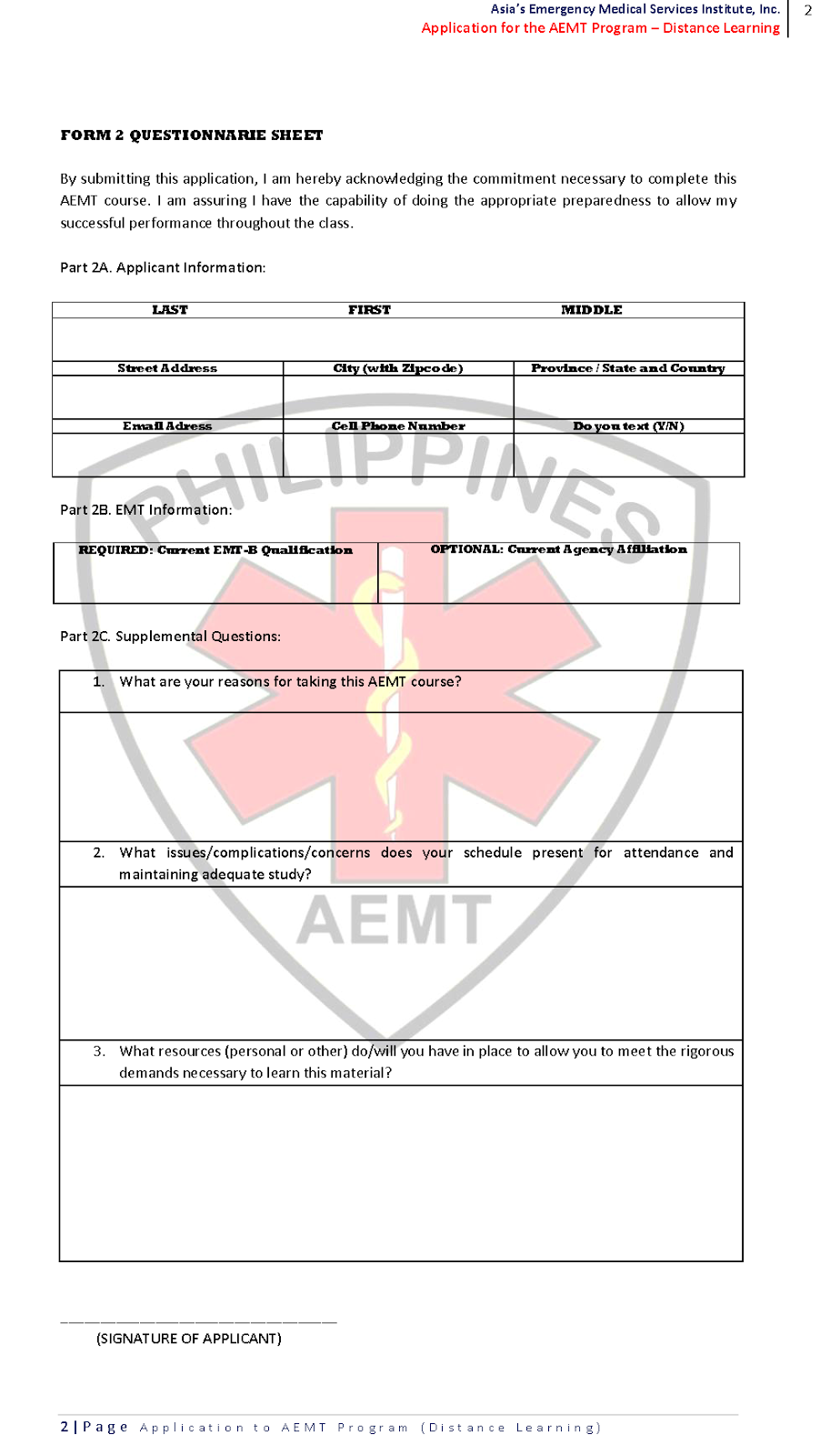
APPLICATION TO AEMS ADVANCED EMT - DISTANCE LEARNING

The AEMT course consists of 3 months of classroom and academic instruction followed by 3 months Clinical / mentored practical phase  (80 Days / 90 Days) whereby the students are then exposed to hospital skills and mentored road response with the necessary hands on {ambulance and response vehicle} with Doctors and Paramedics of AEMS.

For those who are out of the country and working full time, you may apply for the AEMS Advanced EMT Distance Learning Program :

1. Fill up the AEMS Advanced EMT Application for Distance Learning and send to admin@asiaems.org with the following documents :

Checklist of Requirements for the AEMT Course :

a. Resume /CV
b. Possess an EMT B Certificate (not more than 2 years ; beyond 2 years will have to undergo a refresher course)  with TOR
c.  Current Healthcare provider BLS/CPR
d. Certificate of Employment (if currently working)

2. Upon acceptance to the program - Pay the AEMT Course Fee of Php 45,000.00 via fund transfer to AEMS Company Bank Account (Please send us a scanned copy of the bank deposit slip together with the AEMS Registration Form)

Account Name :
Asia’s Emergency Medical Services Institute, Inc.

Account No : 
Current Account 2708019845

Bank Name : 
Banco de Oro 

Bank Address :
Claro M. Recto Branch, Davao City,Philippines

3. AEMS Paramedic/Clinical Instructor will forward AEMT Course Curriculum , Timetable for requirements to be submitted and completed. 

4. Mandatory : Internship (in - country)  to comply the required hours of clinical,hospital and ambulance exposure with AEMS MD and Paramedic Oversight.

AEMS ADVANCED EMT SCHEDULE :

  • March 08, 2015 - Davao City
  • April 13, 2015 - Manila City with Pilipinas911
  • August 03, 2015 - Zamboanga City with Philippine Red Cross - Zambooanga City Chapter

AEMS will only entertain queries for the AEMS Advanced EMT Distance Learning Program upon receipt of the AEMS  Advanced EMT Application Forms with valid proof of I.D.  to avoid scams and phishing emails.

On requests for PDF Format on the AEMS AEMT Application Forms, please email admin@asiaems.org. with your valid I.D.


Monday, 2 March 2015

Pilipinas 911 EMT's on the First AEMS Advanced EMT Course


Pilipinas911 is the only privately run emergency assistance service (EAS) for police, medical and fire emergencies. It operates two 24/7 emergency operations centers with nationwide contacts. Pilipinas911's private emergency assistance service is accredited with the US-based International Academies of Emergency Dispatch (IAED), the standard-setting body for 911 call-taking and dispatching processes. Its Managing Director, Ruel Kapunan,  is a graduate of Political Science from the Ateneo de Manila University, and has worked for NEDA and ADB before becoming an entrepreneur. 

In  Ruel's recent visit to Davao City last February 26 - 28, 2015, I asked him what made him decide to shift to the EAS line of business. According to Ruel, it was in 2009 at the onslaught of Typhoon Ondoy, “When I saw 10 of my employees almost dying from that disaster, I realized that I could use technology, my police contacts and our 24/7 operation to help people in various emergencies,” explains Ruel. That was when he decided to shift from his previous business called Citywatch which provided GPS tracking and monitoring services to companies that had a lot of delivery trucks. When a truck was stolen, got into an accident or broke down, they took care of dispatching responders to the scene, such as the police, local rescue and towing services. Ruel studied the intricacies and workings of the 911 system, he was inspired of its effectiveness in saving lives. 

Pilipinas911 was incorporated in May 2013 with focus on  helping people in emergencies. All of its Call-takers are Registered Nurses and are trained to handle all type of emergencies.

“From the day that we started Pilipinas911, the commitment to provide the best possible service for our subscribers is top priority. With our adoption and implementation of this world-class system, we are confident more than ever that we will be at the forefront in providing professional pre-hospital care.” Ruel said. The commitment to subscribers' in providing quality and professional pre-hospital care is what led to Ruel's decision to enroll Pilipinas911 EMT's to the first AEMS Advanced EMT Course in the Philippines.  

Advanced EMT Course :

The  AEMT course will run for 3 months of classroom and academic instruction followed by 3 months clinical /mentored practical phase  (80 Days / 90 Days). 

Students will be  exposed to hospital skills and mentored road response with the necessary hands on {ambulance and response vehicle} with medical oversight of Doctors and Paramedics

AEMS Paramedic Instructors are registered with  Healthcare Professions Council of South Africa (HPCSA), a government registry and recognized by UK's government registry Health and Care Professions Council (HCPC UK). Our instructors also hold certification and registration with Australasian Registry of Emergency Medical Technicians (AREMT)  as Assessors,

AEMS is a dynamic team of professionals who formed the crux of the AEMS Philippines Group. Our AEMS Head of Training, Mr. Craig Gibson, REMT-P is backed by 22 years of experience in the EMS Industry as an Intensive Care Paramedic and is responsible for standards of training across the board.  Mr. Paul Barson, our  EMS Director   brings with him paramedic, military and remote site experience. He is also a fully registered and licensed EMT-P / Instructor and current remote site specialist bringing with him over 26 yrs experience to the forefront of the AEMS platform.  Together, they have a combined experience of almost half a decade.

AEMS sister company in South America - Suriname Asia's Emergency Medical Services (SURAEMS) had its launching at Court Marriot, Suriname, Paramaribo in South America last February 27, 2015. AEMS representative in country, Managing Director Roel Brug is an Emergency Trauma Registered Nurse with remote site medical experience. The memorable event was attended by representatives from the Ministry of Health, Suriname Red Cross, MedLab, Suriname Police Department and Firefighter Department as among its esteemed guests.

AEMS' mission is to prepare students to possess the knowledge, skills and right attitude to practice competently the art and science of pre-hospital paramedicine in conjunction with medical direction.

Pilipinas911 and AEMS agrees on the same principle - To give the best quality pre-hospital patient care, constant training upgrades and quality improvement must be maintained.

The first batch of Advanced EMT Course in Manila  will start on April 13, 2015. Individuals applying for  acceptance to the Advanced Emergency Medical Technician Course must meet the following requirements:

1. 18 years of age or older.

2. Possess a current qualification at the EMT-B level

3. Retention of a registered EMT-B level and minimum of 250 logged hours / calls at the EMT-B level or higher.

4. If no valid proof of active EMT service within the last 6 months, must undergo a Skills Refresher Course of 10 days under AEMS.

Kindly submit notarized proof of all professional certification for  preliminary examination/evaluation before acceptance to the AEMS AEMT course.

For interested applicants with full time job, kindly include your Certificate of Employment for us to schedule a second class after work hours to make it possible  for you to avail of  the AEMS Advanced EMT Course.

Application for Distance Learning is available for those who are working out of the country. For more info about the AEMS Advanced EMT Course, queries may be sent to info@asiaems.org. 


Saturday, 28 February 2015

AEMS FIRST ADVANCED EMT COURSE IN THE PHILIPPINES!


The First Advanced EMT Course through Asia's Emergency Medical Services Institute, Inc. 

10 RESERVATIONS CONFIRMED WITH ONLY 30 SLOTS REMAINING!!!

Asia's Emergency Medical Services Institute, Inc. will be launching the First Advanced EMT Course in the Philippines  with below schedule :


  • March 09, 2015 - Davao City 
  • April 13, 2015 - Manila City
  • August 03, 2015 - Zamboanga City at Philippine Red Cross - Zamboanga City Chapter

The AEMT course consists of 3 months of classroom and academic instruction followed by 3 months Clinical / mentored practical phase  (80 Days / 90 Days) whereby the students are then exposed to hospital skills and mentored road response with the necessary hands on {ambulance and response vehicle} with Doctors and Paramedics. {Students can choose to do this at a recognized facility close to home if they so please, but final skills are evaluated by the AEMS medical panel for completion purposes} 

Individuals applying for Advanced Emergency Medical Technician must meet the following requirements:

1. 18 years of age or older.

2. Possess a current qualification at the EMT-B level

3. Retention of a registered EMT-B level and minimum of 250 logged hours / calls at the EMT-B level or higher.

4. If no valid proof of active EMT service within the last 6 months, must undergo a Skills refresher course of 10 days under AEMS.

5. Kindly submit notarized proof of all professional certification for a preliminary examination/evaluation before acceptance to the AEMS AEMT course. 

6. AEMT Course Fees :

Reservation Fee of Php 5,000.00 
Registration Fee of Php 10,000.00 prior to start of AEMT Course
Balance of Php 30,000.00 to be split in 2 months.

For reservation of slots for the AEMT Course, kindly email admin@asiaems.org and state in subject line : AEMT RESERVATION

LEVEL - UP and be among the FIRST AEMTS in the Philippines!


AEMS Scope of Practice Model defines and describes three  levels of EMS professionals. 

• Medical Responder (EMR) (Non - Professional) 
• EMT (
• Advanced EMT (AEMT)
• Paramedic

Each level of EMS professional differs in knowledge, skills, judgment, critical thinking, and decision making. Not every country recognizes all levels of EMS professionals. Although the various levels of EMS professionals may differ from one country to another,  all EMS professionals work to provide the best patient care at their level of training and expertise.
Each level of EMS professional has its own scope of practice. 

The  scope of practice for an EMT is not the same as the scope of practice for an AEMT or
a paramedic. Scope of practice is regulated by the state or country where the individual works and by the medical director.

As new technology or research appears, an EMS professional's scope of practice should change. These changes will reflect the new norms or expectations. An EMS professional can be legally liable if he or she functions outside his or her scope of practice.

Emergency Medical Responder 

                                                                     
A Certified Emergency Medical Responder (EMR) is an EMS professional who provides initial basic life support care to patients who access the EMS system. EMRs were formerly called first responders. An EMR must work with an EMT or higher level personnel during the transport of emergency patients.


Emergency Medical Technician 


A Certified Emergency Medical Technician (EMT) is the minimal level of training required  to transport a patient to an acute care facility. This level of EMS professional can provide non-invasive emergency care, including performing assessments, administering oxygen, and immobilizing a patient.   An EMT can assist patients in taking their own prescribed medications. An EMT can also administer specific over-the-counter medications (such as aspirin and oral glucose) with appropriate medical oversight. 


Advanced Emergency Medical Technician (AEMT) 

A Certified Advanced Emergency Medical Technician (AEMT) is an EMS professional who provides basic and limited advanced skills to patients who access the EMS system. An AEMT was formerly called an EMT-Intermediate. This level of EMS professional varies drastically from country to country .In some country  AEMT skills include giving  dextrose to patients who have a low blood sugar and starting intravenous lines. In other countries, AEMTs can perform advanced airway skills (including endotracheal intubation), apply cardiac monitoring, and give cardiac and respiratory medications. 

Paramedic

A cerified paramedic is the highest level of EMS professional in the pre-hospital setting. This level of EMS professional performs advanced assessments, advanced procedures, and medication administration. A paramedic is competent in all the skills of the EMR, EMT, and AEMT and also can perform a broader range of advanced procedures that the other levels cannot.

Specialized Levels

More specialized levels are specific to individual states like in South Africa, US and UK.  Generally, specialized levels are not replacements for the standard four levels, but rather additional training one can take after receiving the initial EMT or Paramedic credentials. For example :  A  wilderness EMT course is available for EMS personnel who work in remote areas. This course focuses on the long-term stabilization of patients within limited resources.
Paramedics are licensed healthcare professionals who provide the most extensive pre-hospital advanced life support. Paramedics provide care that is on par with that of the emergency room. During a medical emergency Paramedics can provide advanced life support care including: advanced airway management, endotracheal intubation (breathing tube), manual defibrillation, external transcutaneous pacing, EKG monitoring, 12-lead EKG acquisition, IV fluid therapy, intraosseus infusions, hemodynamic monitoring, needle chest decompressions, surgical airways, administration of a wide array of critical care medications and mechanical ventilation.

A certified and licensed critical care paramedic course teaches paramedics additional pharmacology and skills, such as the use of balloon pumps, to help with the care of critically ill patients who depend on equipment. Critical care paramedics commonly work on critical care transport ambulances, which are used to move patients between health care facilities.
Craig Gibson &  Paul Baron ,REMT-P's
Other examples of expanding and emerging roles for paramedics include primary care, industrial medicine, sports medicine, and tactical medicine.

A certified and licensed Intensive Care Paramedic is an advanced clinical practitioner in Paramedicine who provides medical assessment, treatment and care in the out-of-hospital environment for acutely unwell patients with significant illness or injury. ICPs respond to patients experiencing an acute, life threatening emergency. They provide rapid and specialist clinical assessment by implementing a targeted management plan for patients with significant alteration or challenge to normal homeostatic function.  Whilst this role is tasked with providing clinical oversight during the management of these cases all patient care is undertaken in collaborative context with other paramedic staff or health care professionals in attendance.The ICP is required to make rapid, often complex and critical clinical judgment without direct supervision. Individuals are responsible for their own continuing professional development which may be supplemented by employer-provided training.

AEMS Paul Aiden Barson, REMT-P in Sudan
An ICP is usually engaged by a statutory ambulance service, private paramedic service or defense force and may operate in a variety of community, industrial, resource sector, defense or event/public gathering settings including disaster response. professional may be deployed as part of a two-person crew operating in an ambulance equipped with a stretcher and specialist clinical equipment or may practice as a single operator from a purpose-designed response vehicle (typically a marked station wagon).Defence force ICP’s deliver out-of-hospital care as solo practitioners and in team environments alongside other health professionals or a merger of specialties. ICP’s engaged in defence forces provide health care to support and maintain the health and well being of defence force/allied personnel and civilians in times of conflict, disaster or peacetime.  This may include the delivery of health care within austere environments and on/in a variety of platforms such as on land (on foot or in-vehicle), aerospace or on ships. They may attend in situations ranging from a controlled environment through to routine and emergency medical management where a paramedical response is required. ICP may take professional responsibility for the mentoring and support of paramedics, developing ICP’s, paramedics and students.
Craig Gibson demonstrating traction splinting to AEMS students - Davao City.

AEMS Craig Gibson, REMT-P and AEMS EMT's in Kidapawan City's 911.
AEMS's Students on patient care reports - Kidapawan City
AEMS Scholar Alpha in Kidapawan City. 

The AEMS Paramedic Instructors :

Paul A. Barson, REMT-P has NDip in Paramedical Sciences from Churchill Education Australia, is an ALS (Advanced Life Support) Paramedic and an EMT Assessor of AREMT (Australasia Registry of Emergency Medical Technicians), currently registered and licensed with Health Professions Council of South Africa (HPCSA), the government agency handling Paramedic licensing and registration of healthcare professionals and paramedics in South Africa  and has more than 20 years of professional experience in the EMS field as Paramedic/Project Manager with international & national institutions both in the medical and rescue industry, with extensive field work in Sudan, Afghanistan, Somalia and South America. Paul is a Remote / hostile Site Specialist and has an EMS Operations Consultant background inclusive of training and management expertise. Paul is a civilian Paramedic with independent license ( can work without medical supervision of an EMS physician) with Military experience, has spent a large portion of time in hostile and remote locations providing managerial and medical support on the ground as and when it is required. 

Craig A. Gibson,REMT-P is  current and registered as an Independent Intensive Care Paramedic registered with Health Professions Council of South Africa, an EMT Assessor of AREMT (Australasia Registry of Emergency Medical Technicians).  He has more than 20 years of professional experience in the EMS field and remote medicine industry. His previous work experience includes  Hospital Manager for  African Union Darfur Mission in 2005 to 2006. Prior to this position, Craig was project manager for Medical Support Solutions with head office based in the UK.

In 2004, Paul Barson and Craig Gibson worked for  the United Nations Joint Military Commission (JMC) at Nuba Mountains in Sudan for which they were awarded a medal of honor for their  exemplary performance as JMC Paramedic - Head of Medical Services by Brigadier General Jan Erik Wilhelmsenl Chairman of JMC and Head of Joint Monitoring Mission in Nuba Mountains, Sudan.

 https://www.facebook.com/AEMS.Institute/photos/a.311674828957217.1073741924.232956403495727/311677498956950/?type=3&theater

Licensure, Certification, and Registration

To ensure the competence of EMS personnel, all personnel in an EMS system must be certified or licensed by the country  in which they provide patient care. 
Certification and registration is available via TESDA (local) or AREMT (International) through its accredited training centers and  assessors (who are connected directly with a Training Center in the Philippines).  

Although certification and licensure are terms that often are used interchangeably in EMS, their EMS meanings differ from the other.

Local : TESDA 

Qualified graduates of TESDA’s NC II  can find employment as any of the following :
• First Responder 
• Medical First Responder
• Ambulance Care Assistant

Students enrolled in EMS NC II may be required to undergo a Competency Based assessment before graduation.


Internationally Recognized : AREMT


For international certification and registration, EMT’s may undergo a written and practical assessment at AREMT through its accredited assessors and training centers in the  Philippines. 


Asia's Emergency Medical Services Institute, Inc. is an accredited/approved training center of the following internation EMS institutions:


The list of AREMT Assessors in the Philippines...


ASHI Certificate for AEMS


www.asiaems.org

Monday, 3 November 2014

AEMS EMT TRAINING ON JANUARY 19, 2015


Asia's Emergency Medical Services Institute, Inc.'s (AEMS) is a non-profit organization that aims to teach the right knowledge, skills and attitude to practice competently the art and science of pre-hospital emergency care.

AEMS intends to strengthen its mission objectives to create a culture of education that foster's a long-term commitment to healthy outcomes and reduction of health related risks among their students / graduates and their patients. Second is to build a professional training and education center with tie-ups with local educational institutions and local government units in the Philippines. AEMS is currently conducting the
With Chief Psalmer in his office in Kidapawan City
EMT and Emergency Medical Dispatch (EMD) Training  for government staff of Kidapawan City's Call 911 (City Disaster RIsk Reduction Management Office - CDRRMO).  After a careful review of AEMS EMT program, the EMS Chief of Call 911, Chief Psalmer Betralte,  board of director for Red Cross Kidapawan City Chapter and Red Cross Cotabato City issued his recommendation for AEMS training to commence immediately. The nine (9) weeks EMT/EMD Training for Call 911 started last September 15, 2014 and will end this November 20, 2014. It will be followed by 4 weeks of mentored ambulance training handling actual medical emergency cases.  AEMS EMT/EMD Training for Call 911 is the first EMS Training  conducted in Region 12 with AEMS EMT curriculum based on international criterion
Chief Psalmer Betralte with AEMS Paul Barson
combining the  best practices in pre-hospital emergency care from South Africa, UK and the US. 
The program is highly supported by the Honorable Mayor Joseph A. Evangelista who believes in providing the best pre-hospital emergency care for the citizens of Kidapawan City. All of Call 911's services are free for the public. AEMS will be having its next batch of EMT Training this coming January 19, 2015. AEMS strength are its seasoned paramedics who have more than 20 years of road experience and management expertise in the
EMS field. AEMS paramedic instructors are current and registered with and licensed for independent practice by Health Professions Council of South Africa.  Years of experience coupled with the knowledge of the latest protocols and procedures in patient care is what makes our paramedic instructors highly effective in their EMS Training.  Certification and registration for EMT, AEMT and Paramedic it will be under Australasia Registry of Emergency Medical Technicians (AREMT). 

For more info on AEMS Training Programs, please email info@asiaems.org

Tuesday, 28 October 2014

AEMS EMTs on Pre- Hospital Care Delivery

An Emergency Medical Technician (EMT) is an emergency responder trained to provide emergency medical services to the critically ill and in-jured.  Once thought of as an "ambulance driver", the modern EMT performs many more duties than in the past, and responds to many types of emergency calls, including trauma and medical emergencies such as heart attacks, stroke, hazardous materials exposure and childbirth. 


The above female child was delivered inside the ambulance at 2:48 a.m. and childbirth handled by two AEMS trained EMT's Philip Klarc and Ronn Gabriel last October 15, 2014 while on their way to the hospital. 

Photo : AEMS Nurse /EMT Philip Klarc with the newborn. 

Photo : AEMS/Lifeline EMT Ronn Gabriel with the newborn

PROCEDURE FOR OUT OF HOSPITAL DELIVERY:

One person takes charge, others play gofer as needed. In this case it was Philip Klarc who took charge. Philip graduated a nurse and took the full EMT course with AEMS. 

- Clear out non-helpful bystanders.

- Keep calm, keep voice low. 

- Set up clean area that won't accidentally get messed up by mother. 

- Lay out all necessary equipment, set up oxygen.

- Wash hands and arms if there is time. 

-Place clean drape under mother's buttocks (be prepared for gofer to clean away feces if necessary)

-Explain to mother what is happening, as it happens.

-As the perineum bulges, place hand gently but firmly over the introitus and the perineum, to prevent sudden uncontrolled expulsion of the fetal head. 

-Encourage the mother to pant or push very gently, explaining you want to avoid a tear.

- As the head emerges, keep firm gentle pressure on head and perineum until chin delivers.

- Feel for the cord behind the top ear. If found, gently tug to see if it will slip over the head. If tightly wrapped, clamp in 2 places and cut between.

- Suction the baby's mouth and nose. This is mainly important if the amniotic fluid is green or brown colored. Otherwise it's probably not a vital step and can actually cause breathing problems. 

[Note - It is important to suction the mouth before the nose. "The mouth is suctioned first to ensure that there is nothing for the infant to aspirate if he or she should gasp when the nose is suctioned." [From the AAP/AHA Textbook of Neonatal Resuscitation, rev. 3/95, p. 2-12.]

- After head rotates to face mother's thigh, gently press down on head to encourage the top shoulder to deliver.

- When you can see the baby's top armpit crease, lift up on the head to deliver the bottom shoulder. The rest of the baby should follow.

- Suction the baby's mouth and nose.

- Dry the baby vigorously, then DISCARD WET TOWELS and wrap the baby in dry warm clothes or blankets.

- Administer oxygen at 5 liters 1 1/2 inch from baby's face until trunk is pink and hands and feet less blue. Some cyanosis of extremities is expected. Keep rest of baby's trunk and head well covered while administering oxygen as the draft will chill the child.

- If not expected to get to the hospital soon, clamp and cut the cord 10-15 minutes after the birth. (clamp the cord about 3 inches from the abdomen, then 2 inches beyond that, and cut between the 2 clamps.)

- Place the baby on mother's chest, with head lower than feet to allow gravity to assist the baby in clearing the airway.

- Watch for sudden gush of blood and lengthening of cord. This means placenta has detached and is ready to be born. Provide gentle traction on the cord. Placenta will usually be pushed out easily by mother. If it doesn't, get to hospital as soon as possible. Normally, approximately one cup of blood is generally lost with the delivery of the placenta.

- After placenta born, immediately press fingers slowly and gently into abdomen at umbilicus - you'll feel the top of the uterus. It may be somewhat spongy or slightly firm or rock hard if she's having a contraction. Do slow and gentle circular massage to encourage contraction of the uterus. This is extremely important, especially if there's a constant flow of blood.

Expedite transport to hospital ASAP.


www.asiaems.org